Beyond Viral Entry: Recombinant Active ACE2 Protein from Cloud-Clone Supports Cardiorenal and Fibrosis-Disease Research
Functionally-validated ACE2 reagents enable mechanistic studies across cardiovascular, virology and pre-clinical
Press Release Disclaimer: This is a press release distributed through the XPR Media network. It has not been independently verified by our newsroom.

Functionally-validated ACE2 reagents enable mechanistic studies across cardiovascular, virology and pre-clinical drug-discovery workflows
HUSTON, TX, UNITED STATES, November 17, 2026 /EINPresswire.com/ — Angiotensin-converting enzyme 2 (ACE2) is widely known as a cellular receptor for several coronaviruses. Beyond its role in viral recognition, this zinc-metallopeptidase performs key physiological functions within the renin-angiotensin system, mediating cardiovascular protection, renal homeostasis and anti-fibrotic responses. Researchers rely on properly folded, catalytically-active recombinant ACE2 protein to explore these biological pathways. Cloud-Clone offers functionally-validated active ACE2 protein to support diverse in-vitro research programs spanning cardiorenal disease, organ fibrosis, host-virus interaction and peptide drug development.
ACE2: Molecular Background and Dual Biological Roles
Angiotensin-converting enzyme 2 (ACE2) is a type-I transmembrane glycoprotein belonging to the zinc-dependent metallopeptidase family. While the canonical ACE enzyme generates vasoconstrictive angiotensin II (Ang II), ACE2 catalyzes the cleavage of Ang II to produce angiotensin 1-7 [Ang-(1-7)], a peptide that drives vasodilation, anti-inflammatory and anti-fibrotic effects. ACE and ACE2 jointly maintain blood-pressure balance and organ homeostasis.
The extracellular domain of ACE2 carries a conserved HEXXH zinc-binding catalytic motif essential for enzymatic activity. Conventional ACE inhibitors such as captopril and lisinopril do not suppress ACE2 catalytic function, granting ACE2 independent value as a research target for drug-discovery projects.
ACE2 is broadly expressed across multiple cell types including alveolar epithelial cells, cardiomyocytes, renal tubular epithelial cells, intestinal epithelial cells and vascular endothelial cells. The membrane-bound ACE2 protein can be proteolytically cleaved to generate soluble circulating sACE2, which participates in systemic signal regulation. Besides processing Ang II, ACE2 hydrolyces additional peptide substrates including apelin and neurotensin, expanding its biological scope to cardiovascular protection, kidney function, pulmonary injury repair and lipid-glucose metabolism.
ACE2 exhibits dual biological behaviour. Under physiological conditions it supports cardiovascular and renal protection; however, multiple coronaviruses utilise the extracellular domain of ACE2 as a host-cell attachment site. The spike-protein receptor-binding domain (RBD) engages ACE2 to facilitate viral entry. Virus binding and internalisation can trigger loss of surface ACE2, resulting in Ang II accumulation, amplified inflammatory signalling and multi-organ injury. This dual profile makes well-characterised recombinant active ACE2 an important laboratory tool bridging cardiovascular research, virology and pharmacology. Recombinant ACE2 must retain native enzymatic activity and receptor-binding capacity, placing high demands on protein conformation and quality control.
Functional Validation of Cloud-Clone Recombinant ACE2 Protein
For recombinant protein products, high purity or high concentration alone cannot guarantee biological functionality.
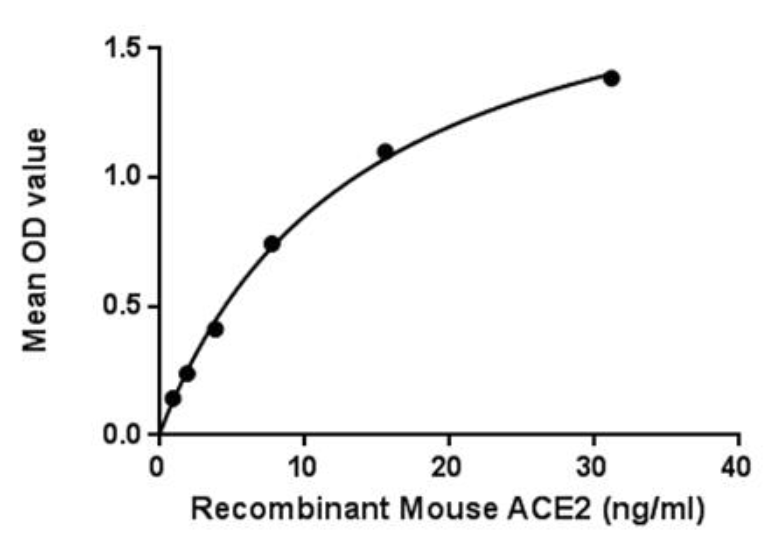
ACE2 serves as the primary host entry receptor for HCoV-NL63, SARS-CoV and SARS-CoV-2. The S1 subunit of coronavirus spike protein binds the extracellular catalytic domain of ACE2, triggering endocytosis of virus-receptor complexes. To verify this molecular interaction, a binding ELISA assay was performed with recombinant mouse ACE2 and recombinant spike S1 glycoprotein. Serially-diluted recombinant mouse ACE2 was added to S1-coated microplates and incubated at 37 °C. After PBST washing steps, anti-ACE2 polyclonal antibody and HRP-conjugated secondary antibody were applied sequentially. Chromogenic substrate was added for colour development, and absorbance was measured at 450 nm following stop-solution addition. The assay demonstrated dose-dependent binding between recombinant mouse ACE2 and spike S1 protein.
(Figure 1. Dose-dependent binding between recombinant mouse ACE2 and coronavirus spike S1 protein, measured by ELISA. Mean optical density (OD) values are plotted against increasing concentrations of recombinant mouse ACE2 (ng/mL).)
Core Research Areas Supported by Active ACE2 Protein
Owing to its dual-function profile, active ACE2 protein supports research across six major thematic fields.
1. Renin-Angiotensin System and Cardiovascular-Disease Research
Active ACE2 protein enables in-vitro reconstruction of the ACE2 / Ang-(1-7) / MasR signalling axis for investigating vascular relaxation, myocardial remodelling and atherosclerosis. In pre-clinical models for hypertension and cardiac hypertrophy, ACE2 reagents are applied to study endothelial protection and anti-fibrotic mechanisms, supporting in-vitro screening workflows for RAS-targeted small-molecule candidates.
2. Viral-Host Receptor-Interaction Research
Active ACE2 acts as a binding target for spike protein and RBD fragments to quantify molecular-binding affinity. It is utilised in pseudovirus-based in-vitro neutralisation assays to assess the inhibitory potency of neutralising antibodies, nanobodies or soluble receptor candidates, and serves as critical material for structural studies of virus-host recognition. Correct protein folding is essential, as mis-folded ACE2 will produce unreliable affinity measurements.
3. Renal Injury, Fibrosis and Metabolic-Disease Research
High renal ACE2 expression makes active ACE2 protein valuable for investigations of diabetic nephropathy, interstitial renal fibrosis and acute kidney injury. Researchers explore how ACE2 modulates renal inflammation, mesangial-cell proliferation and extracellular-matrix deposition to identify potential intervention targets. ACE2-related studies also extend toward glucose-lipid homeostasis, obesity and insulin-resistance mechanisms.
4. Acute Pulmonary Injury and Inflammatory-Response Research
Loss of ACE2 disturbs pulmonary renin-angiotensin balance, driving endothelial barrier impairment and inflammatory-cell infiltration. In studies related to acute respiratory distress syndrome (ARDS), active ACE2 protein helps build in-vitro pulmonary-injury models and characterise inflammatory signalling networks, supporting compound screening for candidate therapeutic agents.
5. High-Throughput Screening for Enzyme Inhibitors and Peptide Therapeutics
Assays built upon ACE2 enzymatic-activity readouts support high-throughput evaluation of candidate peptides and small-molecule compounds, to identify molecules that enhance or suppress ACE2 catalytic performance. This workflow contributes to pre-clinical development of peptide- and protein-based biologics.
6. Structural Biology and Protein-Interaction Studies
Together with SPR, ITC and Co-IP platforms, ACE2 protein enables quantitative measurement of binding-kinetics parameters for diverse partner molecules. The reagent can be prepared for protein crystallography and cryo-electron-microscopy sample preparation. It may also serve as immunogen for generating ACE2-specific monoclonal and polyclonal antibodies.
Common Experimental Applications for Active ACE2 Protein
Active ACE2 protein supports a broad portfolio of laboratory assays:
1.In-vitro enzyme-activity and enzyme-kinetics assays: Co-incubate ACE2 with fluorogenic substrates to measure enzymatic units, Km and Vmax values, for assessing modulatory effects exerted by small-molecule or peptide compounds.
2.Molecular-interaction assays (SPR / ELISA / BLI): Immobilise ACE2 onto sensor chips or microplate surfaces for measuring binding affinity (KD) against spike-protein or RBD analytes; screen agents capable of disrupting ACE2-RBD interaction.
3.Pseudovirus neutralisation and in-vitro blocking assays: Pre-incubate pseudovirus with soluble ACE2 or test antibodies within cellular infection systems, to quantify the level of viral-entry blockade. This workflow is widely adopted for evaluating neutralising-antibody potency.
4.Cell-function assays: Exogenously supply active ACE2 protein to vascular endothelial cells, renal tubular epithelial cells or alveolar epithelial cells. Researchers observe downstream changes in inflammatory-cytokine expression and fibrotic signalling pathways such as TGF-β/Smad, and establish cellular in-vitro models for RAS-pathway studies.
5.High-throughput drug screening: Build screening systems based on ACE2 enzyme-activity signals to profile compound libraries for ACE2-modulating candidates for drug-discovery pipelines.
6.Immunogen preparation and antibody development: Use ACE2 protein as immunogen for animal immunisation to generate polyclonal or monoclonal antibodies. It can also act as positive control material for western blot and immunohistochemistry antibody-validation work.
Cloud-Clone Recombinant Active ACE2 Protein
Full biological function of ACE2 depends on properly folded zinc-catalytic domain and intact extracellular domain. Prokaryotic expression systems often fail to carry out complex glycosylation and correct folding, frequently yielding material with low enzymatic activity. Even eukaryotic expression workflows may generate mis-folded protein, large batch-to-batch variation or elevated endotoxin levels when purification processes are not optimised; such defects can produce negative outcomes in cell-based assays or prevent measurable binding signals on SPR instruments.
Cloud-Clone utilises optimised eukaryotic expression and purification workflows to produce recombinant ACE2 protein with preserved biological function.
Product Compatibility
Cloud-Clone ACE2 active protein fits research workflows including renin-angiotensin-system mechanistic investigation, virus-receptor interaction studies, neutralising-antibody characterisation, renal-pulmonary fibrosis research, high-throughput enzyme-inhibitor screening, antibody generation and raw-material supply for immuno-assay development, covering both fundamental mechanistic exploration and pre-clinical compound evaluation.
Handling and Storage Benefits
The product is supplied as sterile vacuum-lyophilised material. Short-term ambient-temperature transportation does not compromise functional performance. Repeated freeze-thaw cycles should be limited to fewer than three times to maintain enzyme activity. The protein re-dissolves readily without visible precipitation. Application-oriented technical support is available from the Cloud-Clone technical team.
ACE2 is a multifunctional research target, acting both as a negative regulator within the renin-angiotensin cascade and as a viral-entry receptor. It underpins ongoing research programs across cardiovascular science, nephrology, pulmonary injury and peptide therapeutic development.
Cloud-Clone recombinant active ACE2 protein delivers low endotoxin levels and consistent batch-to-batch performance. It serves as a reliable research reagent for enzyme-activity measurement, molecular-interaction profiling, cell-function assays and neutralising-antibody assessment, supporting mechanistic investigation and pre-clinical drug-discovery projects for cardiovascular disorders, organ fibrosis and virus-related pulmonary disease. Well-validated protein reagents facilitate robust in-vitro experimental outputs and support advancing fundamental knowledge for future diagnostic and therapeutic development.
SuKi Duan
CLOUD-CLONE CORP.WUHAN
Visit us on social media:
LinkedIn
Instagram
TikTok
X
Legal Disclaimer:
EIN Presswire provides this news content “as is” without warranty of any kind. We do not accept any responsibility or liability
for the accuracy, content, images, videos, licenses, completeness, legality, or reliability of the information contained in this
article. If you have any complaints or copyright issues related to this article, kindly contact the author above.

Media gallery